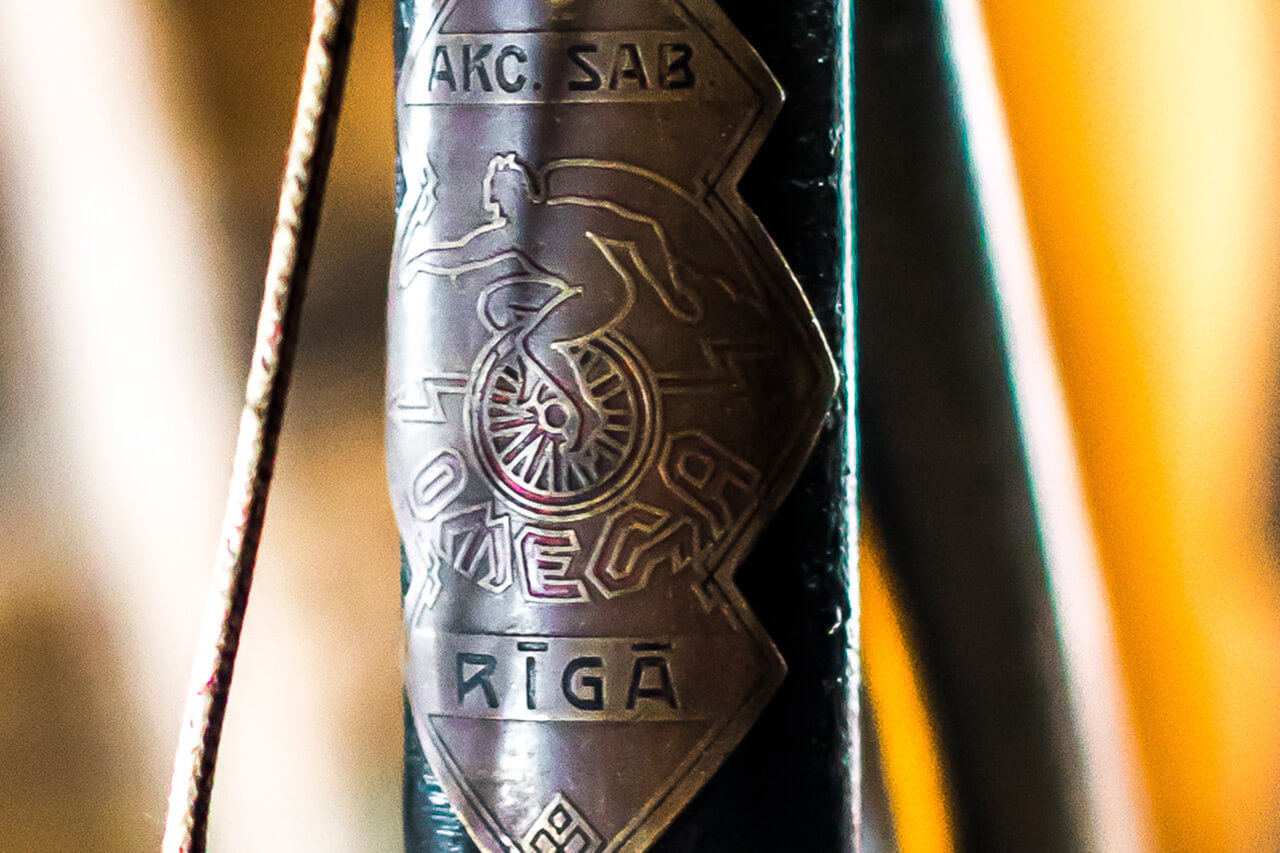
Omega Joint-Stock Company, 1927–1940
The year 1927 is considered the start of the independent operations of the joint-stock company “Omega,” when Gustavs Ērenpreis left the company “G.Ērenpreis and Partners,” which was located in the former premises of the A. Leitner bicycle factory on Brīvības Street.
The “Omega” bicycles manufactured at the G. Ērenpreis factory had already gained popularity among cyclists due to their high quality.
1928. In [year], a lucrative contract was signed with the USSR trade mission for the delivery of 3,000 bicycles to the Soviet Union. In the following years, the volume of deliveries was expected to increase. “Omega” also signed a supply contract with the Latvian Army’s cycling unit and began fulfilling a large government order. This generated significant profits for the company and opened up opportunities for the factory’s expansion.
In 1930, the joint-stock company purchased the property at 36/38 Kalnciema Street, where construction began to build a modern, high-yield factory. The most advanced specialized machine tools and equipment were purchased from abroad. Several highly qualified engineers and master craftsmen were invited from abroad. A new rolling mill for wheel rims and mudguards began operations. In 1931, a modern chrome-plating facility began operations, and for the first time in Latvia, the main bicycle parts were coated with shiny and durable chrome.
Politics put an end to all the work that had gotten off to such a good start. In 1932, the Latvian government denounced the trade agreement with the USSR. Bicycle production dropped sharply. The company suffered significant losses due to the inability to use the expensive raw materials purchased from abroad.
However, solutions to the crisis were found, and as early as September 1935, the factory began moving to its new premises at 36/38 Kalnciema Street.
Since early 1937, the factory had established a successful partnership with the Liepāja Military Port Workshops (KOD) and the later state-owned enterprise “Tosmāre.” Production of KOD free-running engines began in Liepāja, based on the German Torpedo model, and “Omega” became the buyer of this company’s products, which were specially marked with the “Omega” trademark. “Omega” was a diversified company. It manufactured not only bicycles but also tableware, razors, and skates, and also performed repairs on cars and motorcycles.
All of the well-established manufacturing and sales processes were interrupted by the Soviet occupation in the summer of 1940. The joint-stock company was nationalized. In place of the bicycle factory, a state-owned metalworking enterprise called “Omega,” subordinate to the Ministry of Local Industry of the Latvian SSR, was established.